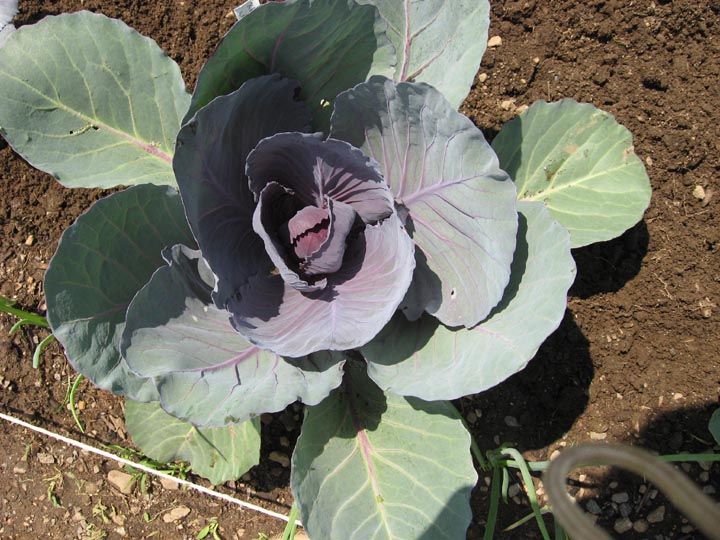
This is a red cabbage.
A Cooperative Learning Project
This is a red cabbage.
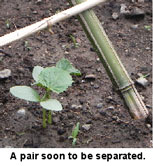 The cucumber shoots are up.
We had planted the cuke seeds in pairs in 2-foot intervals on either side of the compost bins. Of the 8 seeds planted, 6 germinated, producing nice healthy shoots, a pair and a single on either side. To improve the odds of getting an abundant crop, we separated one of each of the pairs and replanted them to the center spot between those remaining. So now the spacing is 12 inches between plants, still 3 on either side of the bins.
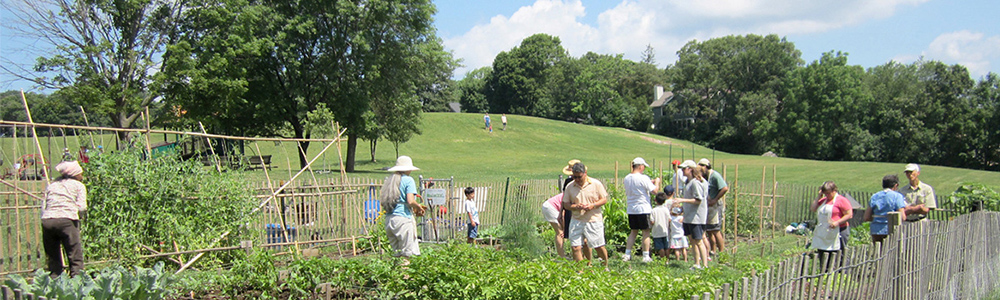
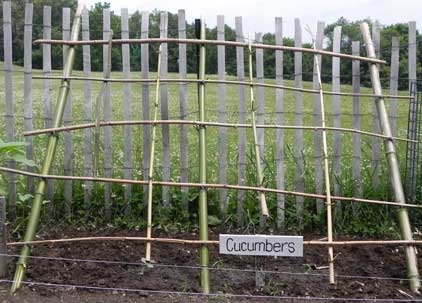
Elizabeth, our CGO (chief growing officer) says to expect an explosion of cukes. To make provision for that, Alan, chief engineer, has built two growing ladders, one on either side of the bins, in readiness for the onslaught to come.
Always looking for a little action, I proposed we run a cucumber pool: $1 a slot on the number of cukes we actually get out of the garden. So far, no takers on that.
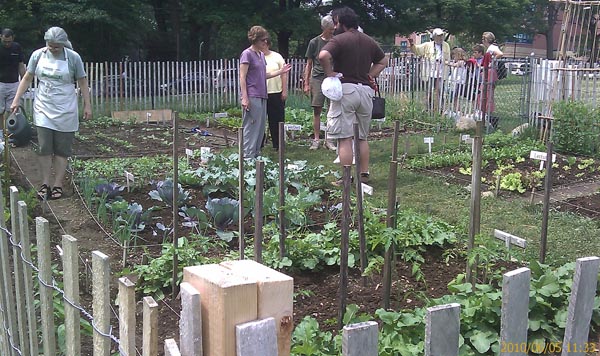
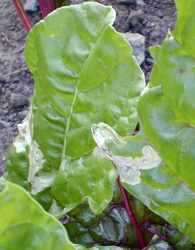
The swiss chard seedlings are up and growing, but in need of a bit of thinning and transplanting. The rows are just under a foot apart and we’re progressively thinning the plants so that they will be 4 to 6 inches apart. The promise is that these plants, once mature, will continue to produce for us throughout the gardening season.
We’ve had some leaf miner damage on the early leaves. The worst of the infestation appears to be over, although some of the plants continue to bear scars.
Tens of thousands of years ago, glaciers scraped and re-scraped the New England landscape. Soil was pushed away, and among the artifacts left behind were drumlins: mounds of glacier till, flowing in the direction of the glaciers (northwest to southeast in NE), consisting of silt, clay, and gravel. One such drumlin is the hill upon which Robbins Farm Park resides. And what is "gravel" to a glacier includes what farmers and gardeners call "rocks."
When in April we turned over the grassy sod to unearth a potential garden, we also found rocks: lots of them. 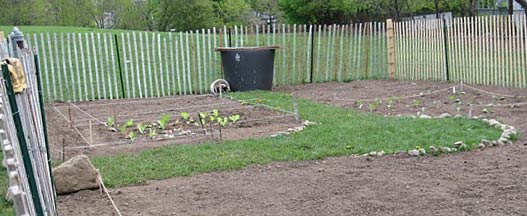 Rocks are not useful to growing plants — they are not soil, they hold no water. Carrots will grow around pebbles, twisting and branching, rather unlike the straight ones store-bought. Removal is the typical response to rocks in the garden. Rock-weeding really, as pebbles work their way upwards, again and again. Mix into a bowl some sand and some pebbles; shake it gently to see the pebbles cluster atop; the same happens in the garden, just slower.
But rocks don’t have to be useless waste, even for a garden. The early farmers of New England made low fences of their rocks, giving Robert Frost’s last line of his poem "Mending Wall": Good fences make good neighbors. What have we done with our rocks? The largest two we set as showpieces at the garden entry, big enough to sit on (especially if you’re small). Others we hammered into holes to brace the bottoms of our posts. But one artist among us saw that they could be beautiful, and lined our two main walkways with an elegant, flat-side-up, rock border.
The cabbage patch has been invaded … by tomatoes! The spaces formerly occupied by the two culled seedlings were filled last Saturday by the tomato committee. A couple other plants are doing poorly — while some are doing very well. What is the difference? The cabbage family has a shallow root system, and so more vulnerable when transplanting (as ours were), and more sensitive to being underwatered. The question is whether the early stunted growth can be overcome by warmer weather, rich sunlight, and good watering.