On January 28th at 10 AM, the Robbins Farm Gardeners will gather at the Community Safety Building (112 Mystic Street) to begin the gardening season by selecting seeds and crops. From artichokes to zucchini, all are invited to share in our excitement about what we’ll be growing (and eating) this year!
Wintering-over Rosemary
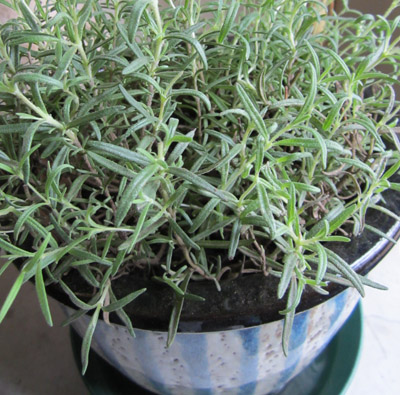
Sadly, the lovely rosemary we grew in the garden isn’thardy in Arlington. So we potted the plant before the first hard freeze and are keeping it indoors for the winter. The progress, so far, is good.
The plant needs as much light and water as it can get in a New England home in winter. It’s in a south-facing window and is checked for water every few days. We’ve also made a point to trim the leggy stems, which make fine additions to many recipes.
Let’s hope we can keep it going until spring!
Kale Chips — crispy, salty, good for you, and easy to make!
As of a few days ago, we still had some greens in the garden, particularly kale. Recently, I — a bit of a "gourmet" potato chip fiend — learned of kale chips as a healthy way to satisfy our cravings for crispy, salty snacks! There are many, many recipes to be found online, most calling for oven baking, with a few instead calling for a food dehydrator. I experimented a bit with the oven methods, since many people don’t have a dehydrator and, also, I figured that baking was likely to give more flavor.
The first step is to cut the heavy stem out from the kale leaves. While some recipes I found suggested using a sharp knife, it turns out that you can tear the kale away from the stem readily. Tear the kale into pieces that will be "bite size" once they’re dehydrated. About a 3 to 4 inch dimension seems to work fine.
I washed the kale pieces thoroughly in water, and dried them as well as possible. I used a salad spinner and then blotted them with a towel.
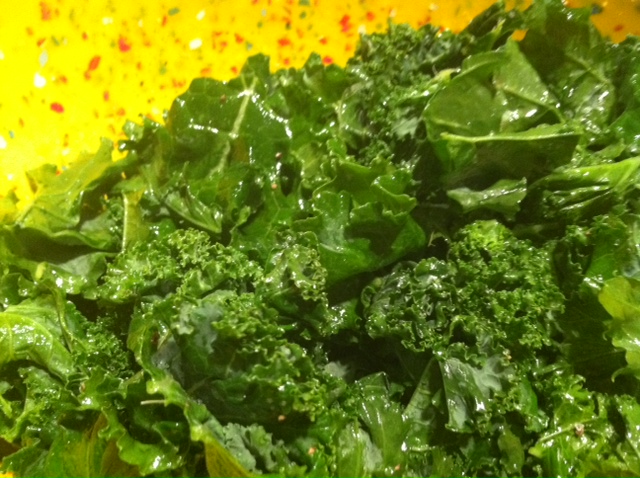
Then, I placed the kale pieces in a bowl, and added some extra virgin olive oil (at least I hope it was EVOO — mine was from Trader Joes). I massaged the olive oil into the leaves, so that all were as evenly coated as possible. Then, I seasoned them generously with sea salt and fresh ground black pepper. The coated kale looks like this:
I then spread the kale in a single-thickness layer on a baking sheet. Some of the videos stressed that the layer must be only one leaf thick, warning that if the kale is piled up, it won’t become crispy. (I chose not to test this theory, so have only tried the single layer.) Before baking, it will look like the photo below, and will shrivel up considerably and darken in color, as described below, as it bakes.
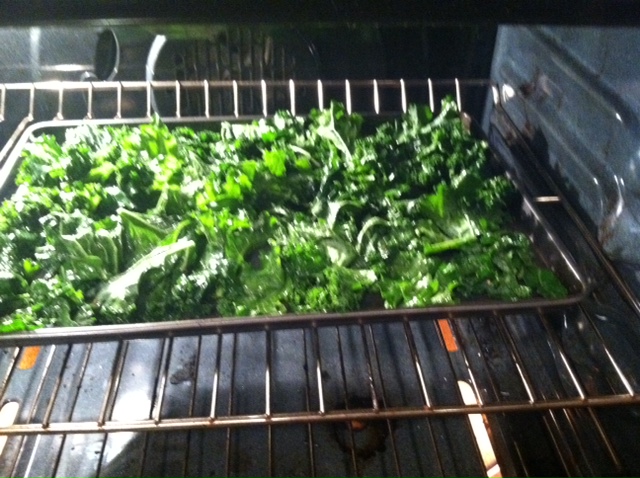
I baked the kale in an oven set for 350 degrees F. Some of the recipes said that only 10 min was needed to get them fully dehydrated and crispy. I tried the recipe in two ovens, and one took at least 15 min and the other took 20. (Both ovens were set on convection, which automatically sets the temperature to 325 degrees. This may have been the issue.) It’s a good idea to just watch them and make sure that they do not burn. They should reach a fairly uniform dark green color, and appear curled up and considerably smaller than the original pieces.
After they’re fully crisped up as described above, the kale chips can be very gently blotted on paper towels to remove excess oil.
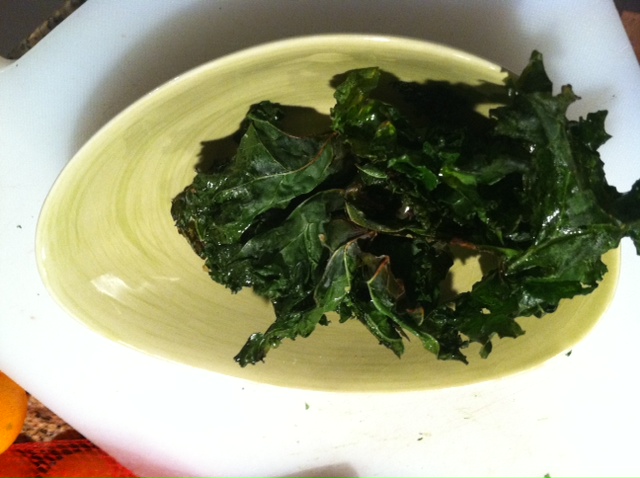
These are incredibly delicious and crispy straight from the oven! Whatever you do, do not store the uneaten chips in a sealed container. This makes them lose their crispiness. If there are any leftover, I would suggest storing them in an open bowl. The finished kale chips, with their dark green color, are shown in the third photo, below. The moistness you see on the chips is residual olive oil. These are definitely finger food, but you will want some napkins handy.
While of course this is best with local, fresh-from-the-garden kale, if you crave this snack "off season", I found that a Trader Joe’s bag of precut and washed kale works great. One bag will fill two large baking trays.
By the way, this is by no means the "perfect recipe" for kale chips. If anybody has variations to suggest based on their own kale chips experiences, please add them in the comments section. I’m also curious about other seasonings, as well as other greens that might also be used to make chips.
Viability Periods of Various Veggie Seeds
To help save money when buying vegetable seeds, check the viability of seed varieties and order larger packets of seeds that are long-lived.
Assess your remaining seeds from last season. If you liked a particular variety, continue to use the seed. Because seed can remain viable for years, if properly stored, it is often economical to buy larger packets at reduced prices.
Here is a general list of seed viability for some common vegetable crops:
Short-lived seeds (1 – 2 years)
* corn
* leeks
* onion
* parsnip
* spinach
Medium-lived seeds (5 years)
* squash
* pumpkin
* peas
* eggplant
* parsley
* beans
* carrots
* celery
Long-lived seeds (over 5 years)
* broccoli
* lettuce
* collards
* cabbage
* cauliflower
* brussel sprouts
* kale
* tomato
* radish
* cucumber
* melon
* peppers
* turnips
Help Select Some Heirloom Tomatoes for our Next Season!
RF Gardeners,
To help us plan what we’d like to cultivate next season….
Here’s a list of the Top 10 Heirloom Tomatoes for 2012:
http://www.hortmag.com/plants/fruits-veggies/top-heirloom-tomatoes?et_mid=527783&rid=2167011
Please vote for your top 3!
– Mike
First New Veggie in Ten Years!
Hi All,
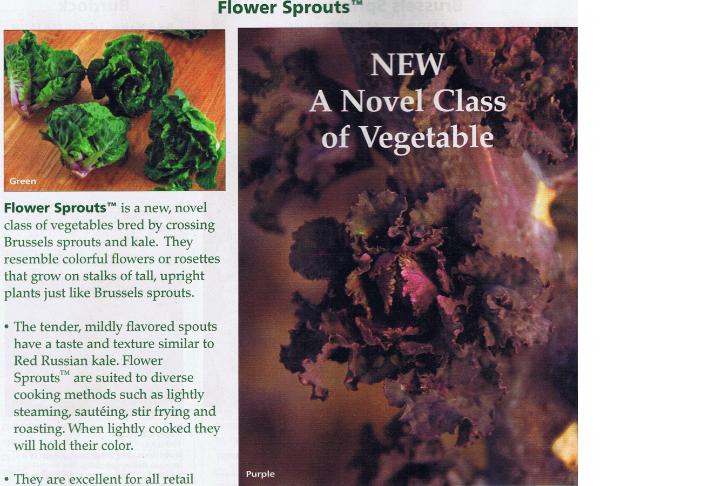
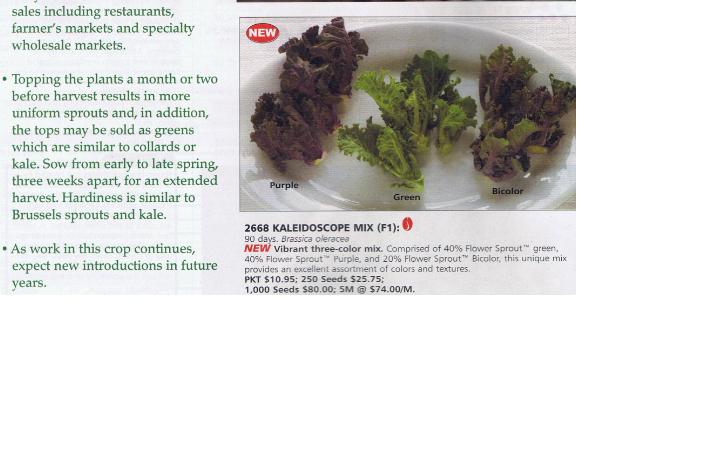
I just received my 2012 catalog from Johnny’s Selected Seeds, and in it they offer this new cross between Brussels sprouts and kale, called Flower Sprouts! The first new veggie to be developed in about ten years, this sounds like it could be fun, educational and tasty to try!
This is a scan of the catalog page:
Some related videos:
http://www.youtube.com/watch?v=92Rtbm19-ec&feature=related
http://www.youtube.com/watch?v=jTbEet_KvF8
For more cultural info, go to http://www.johnnyseeds.com/p-8665-kaleidoscope-mix-f1.aspx and click on the “Growing Info” tab.